

Economic Insights

Cost of living crisis

UK Cost of Living Crisis

560 315 Jess Easby

Cost of living crisisFunding the retirement lifestyle you want vs the cost of living: time to get your retirement plans in motion!

One of the most common concerns among those approaching retirement is whether they will have enough money to last them with only 25% of retirees feel very confident they’ve saved enough for retirement.

The cost of living crisis

As food prices continue to soar and petrol costs reach an all-time high in the UK, the rising cost of living is without doubt having an impact on many people’s financial plans, both short and long term.

If you’re approaching retirement or have already started taking money from your pension or other retirement savings, you wouldn’t be alone in feeling a little anxious about the effect the cost-of-living crisis might have on your lifestyle in retirement. While it’s impossible to predict the future with complete certainty, there are a few things you can do to feel more confident about spending your money in retirement.

Add up all sources of income

Your main source of retirement income may well be your pension plan. But when it comes to planning your finances in retirement, it’s important to think beyond this. Consider other potential sources such as Individual Savings Accounts (ISAs) and other investments, as well as any rental income you receive from rental properties you let.

Don’t forget the State Pension, which is currently £185.15 a week (£9,628 a year) for a single person with a full entitlement. Although the State Pension’s annual increase is currently below inflation, every little helps and the total of all your savings and income might add up to more than you think.

Watch out for unnecessary tax bills

Paying too much tax in retirement is a common pitfall for some retirees, and one that could be potentially avoided with having the right plans in place. If you’re already taking or plan to take income from multiple sources, you need to consider how that will be taxed. When and how you take your money can make a big difference to how much tax you pay and how long it will last. Taking money little and often could make all the difference when it comes to reducing your tax bill.

When it comes to your pension savings, you can typically take 25% tax-free from age 55 (age 57 in 2028), either in one go or spread out over a longer period. After this, any money you take from your pension savings, as well as your State Pension, is taxable just like any other income.

That means you’ll need to pay income tax on anything over your tax-free cash limit and any annual personal Income Tax allowance you get. It’s likely that the more money you take, the more tax you’ll have to pay, although how much will depend on which tax band your income falls into. So if you take all of your pension savings at once, or in big lump sums, you could be paying more tax than you need to. But by taking your pension savings over a number of years and taking just enough to stay in the lowest tax band you can, you could keep more of your money overall.

Make the most of your individual savings accounts (ISA)

Another way to avoid an unnecessary tax bill is to make the most of your ISA savings. You don’t pay tax on any investment growth or interest you earn, or on the proceeds you take from an ISA. So it’s a very tax-efficient way to save.

You could consider using any ISA savings you have first and delay accessing your pension savings, giving them more time to stay invested and potentially grow in value. Remember though, the value of all investments can go down as well as up, and you may get back less than you paid in.

Or, if you’ve already started taking an income from your pension, you could use your ISA savings to supplement that income. This could allow you to take smaller payments from your pension and avoid overpaying Income Tax on them. Getting to grips with tax implications can be a bit overwhelming as there’s a lot to consider.

Tax rules and legislation can change, and personal circumstances and where you live in the UK also have an impact on your tax treatment. On top of that, tax varies for other sources of income like property, state benefits, or even your salary if you’re planning on working in some capacity for a little longer.

Keep track of your investments

Where your money is invested could have the biggest impact on how long it will last in retirement. It’s important to regularly review your investments to make sure they remain on track and remain aligned with your plans and attitude to investment risk. For example, your pension savings may be invested in fairly high-risk funds that have the potential to grow significantly in value, but also are more likely to be impacted, particularly during periods of market volatility.

Moving to lower-risk investments means that you’re less likely to see big ups and downs in the value of your pension savings. However, if you’re relying on your pension savings to provide you with a comfortable income for the rest of your life, you also need to make sure that your investments will provide enough growth potential. This is particularly important in the current climate where your money faces the double challenge of rising inflation and potentially having to last for many years.

Want to review your retirement plans?

If you have specific questions about funding your retirement lifestyle, or if you’re feeling anxious about spending money in retirement, speak to us to discuss your options
Key Tax and Pension Changes from the Autumn Statement

560 315 Jess Easby

Last week Jeremy Hunt unveiled his Autumn Statement aimed at tackling inflation and stabilising UK finances. The Chancellor detailed issues such as tax, government spending and energy as part of his plan to navigate the impending recession.

Your Ellis Bates team are busy reviewing your situation given these changes and you will be discussing the implications and actions with your Financial Adviser in your next review.

If you are not currently a client with Ellis Bates and feel now is the time to discuss your tax allowance maximisation, your new CGT position and pension planning in light of these changes, please do not hesitate to book a chat as we are here to help.

Pension Changes

  • State pension triple lock has been retained meaning the state pension will rise by 10.1% in April 2023. Those on the new state pension will receive £203.85 per week (up from £185.15)
  • Pension Annual Allowance (100% of earnings or £40,000) and Pension Lifetime Allowance (£1,073,100) have both been frozen until April 2026.

Your Ellis Bates Financial Adviser will work with you to determine if you need to consider alternative ways to save towards your retirement in light of these changes at your next review.

Income Tax Changes

  • From 6th April 2023, the 45% Additional Rate of Income Tax threshold will be brought down to £125,140 (from its current rate of £150,000)
  • Income tax allowances will be frozen until April 2028 – Personal allowance will remain at £12,570 and the threshold for a higher rate of income tax (40%) will remain at £50,270

National Insurance thresholds will remain frozen until April 2028.

Inheritance Tax

The nil rate band will remain at £325,000, the residence nil-rate remains at £175,000, and the residence nil-rate band taper will still start at £2 million.

Capital Gains Tax Changes

In April 2023 Capital Gains Tax (CGT) annual exempt amount will be reduced from £12,300 to £6,000. It will be reduced further to £3,000 from April 2024

Your Ellis Bates team are busy reviewing your situation given these changes in CGT and will be in touch over the coming weeks.

There will be no change to the rate of Capital Gains Tax:

Tax Band Tax rate for Property Sale  Tax rate for other Asset
Basic Rate 18% 10%
Higher Rate 28% 20%

Stamp Duty

There will be no immediate change to Stamp Duty Land Tax (SDLT), the increases which were implemented on 23rd September 2022 (SDLT nil-rate threshold was increased from £125,000 to £250,000. The nil-rate threshold paid by first-time buyers was increased from £300,000 to £425,000) will remain until March 2025, after which the allowances will revert to their previous levels.

Are you a business owner?

If you are a business owner, a number of changes and support systems were announced:

  • Business Rates multipliers will be frozen in 2023-24 at 49.9p (small business multiplier) and 51.2p (standard multiplier)
  • A Transitional Relief scheme will be implemented to support and help up to 700,000 properties adapt to their new bills from April 2023
  • The Retail, Hospitality and Leisure relief scheme is being extended and increased from 50% to 75% for 2023-24, offering up to £110,000 per business
  • Supporting Small Business From 1st April 2023, the Supporting Small Business (SSB) scheme will cap bill increases at £50 per month (£600 per year) for the next 3 years. This will affect an estimated 80,000 properties.
  • Improvement Relief will now be introduced from April 2024 (originally intended for 2023)
  • Dividend Allowance will be reduced from £2,000 to £1,000 and reduced further, to £500, in April 2024.
  • Entrepreneurs Relief (Business Asset Disposal Relief) remains at 10% CGT if you sell all or part of your business (or its assets) on the profits you’ve made, up to £10m in total.

If you would otherwise pay higher rate CGT (20 per cent), this means you can save up to £1m in your lifetime through entrepreneurs’ relief.

If you are a business owner and an Ellis Bates client, your dedicated Financial Adviser will discuss these changes and how they may affect you and the actions needed in your next annual review meeting.

Stay updated: we update our Financial Advice hub with the latest financial news and insights, so hit the link to stay informed and up to date

If you do not currently receive financial advice from Ellis Bates, please Book a Chat to discuss this raft of tax changes and how we can help.

Sources: https://www.which.co.uk/news/article/capital-gains-and-dividends-tax-changes-in-the-2022-autumn-statement-ac6kT0e7yZ4X
https://www.gov.uk/government/publications/autumn-statement-2022-documents/autumn-statement-2022-html#:~:text=The%20Autumn%20Statement%20sets%20out%20a%20package%20of%20targeted%20support,bill%20increases%20following%20the%20revaluation.

Top Financial Tips

560 315 Jess Easby

In these uncertain times, it’s more important than ever to make sure your finances are in order. We have 10 practical steps to ensure your money is working hard for you.

Recession-proof your Finances

560 315 Jess Easby

10 practical steps to ensure your money is working hard for you

In these uncertain times, it’s more important than ever to make sure your finances are in order. The Bank of England believes that a painful squeeze on our living standards, driven primarily by soaring energy prices, is set to intensify and will push the UK economy into recession later this year.[1]

Making your finances recession-proof is all about taking practical steps to ensure your money is working hard for you. It is vital to be completely honest with yourself about your financial situation.

By conducting a thorough audit of your finances and gaining a comprehensive understanding of all your incomes and outgoings, this will show you exactly where your cash is going and, most importantly, help you identify problematic spending behaviour.

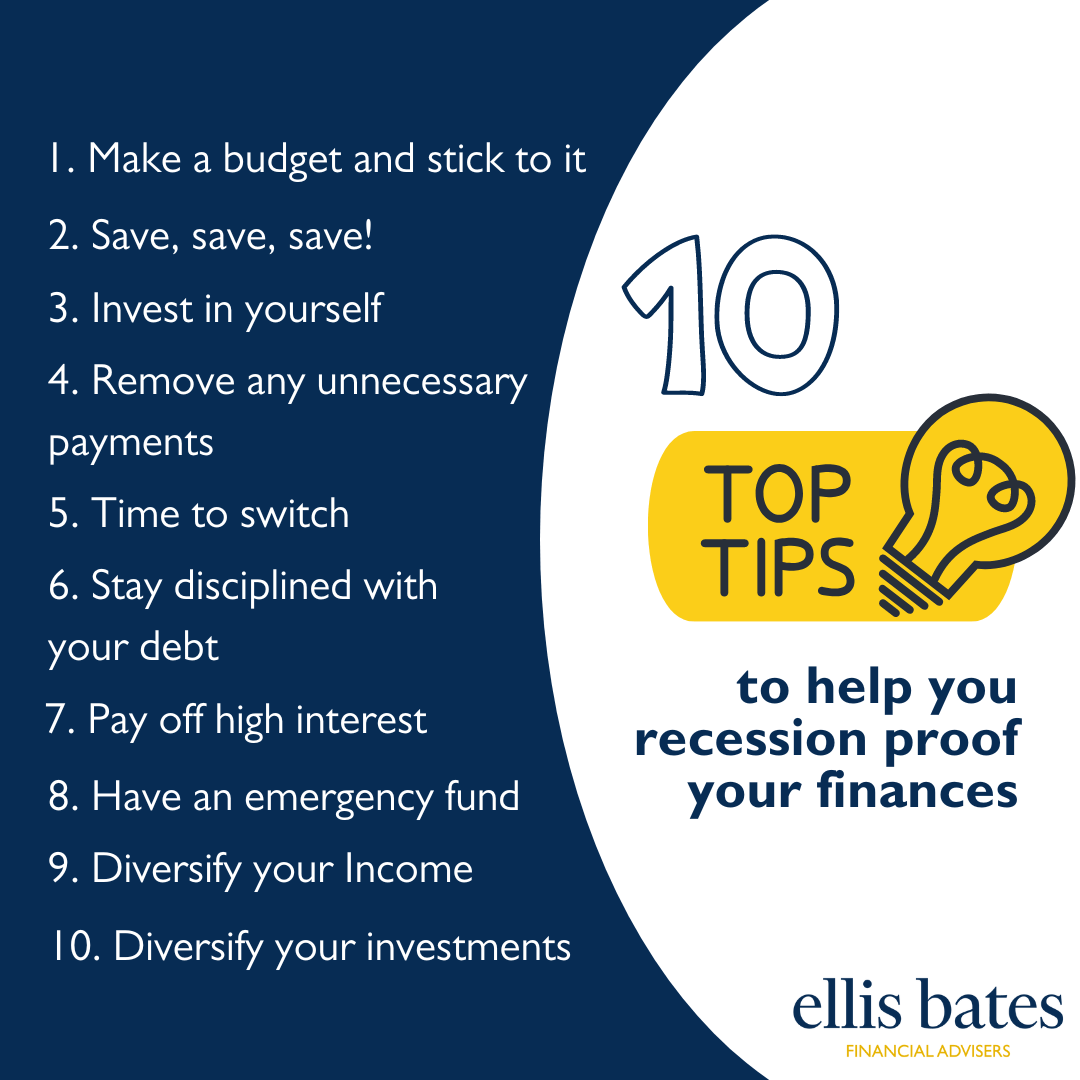
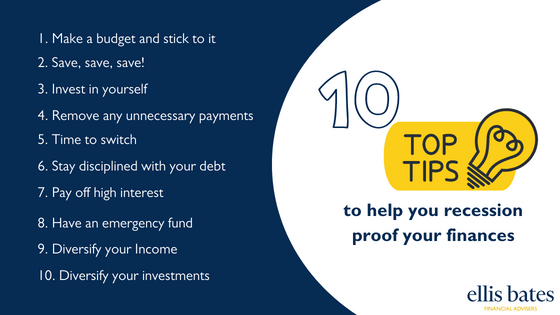
Here are 10 tops to help you recession proof your finances:

1. Make a budget and stick to it

This will help you keep track of your spending and ensure that you’re not overspending.

2. Save, save, save!

Try to put away as much money as you can into a savings account so that you have a cushion in case of tough times.

3. Invest in yourself

Take the time to learn new skills or improve upon existing ones. This will make you more valuable in the job market if you need to make a job or career change.

4. Remove any unnecessary payments

Look at your bank account and remove any pain-free direct debits. Consider if you’re currently paying for things you don’t really need, for example, subscriptions.

5. Time to switch

Look at energy tariffs, home insurance, car insurance, broadband, TV package, mobile tariff – now might be a good time to switch.

6. Stay disciplined with your debt

Make sure you’re making all of your payments on time and in full. This will help you avoid costly late fees and keep your credit in good shape.

7. Pay off high interest

Prioritise any high-interest debt, such as credit card debt, freeing up more money in your budget to cover other expenses if your income decreases.

8. Have an emergency fund

This is a must in case you lose your job or have any unexpected expenses. Try to save up at least between three to six months’ worth of living expenses so that your expenditure is covered.

9. Diversify your income

Don’t put all your eggs in one basket. Having multiple streams of income can really help. If one income source starts to dwindle – or gets eliminated completely – this will provide other sources to fall back on.

10. Diversify your investments

In addition to diversifying your income, it’s also important to diversify your investments. Review your investment portfolio and make sure your investments are spread across different industries and even different types of asset classes.

Secure your financial future

Following these tips will help you secure your financial future and protect yourself from the effects of rising inflation and the cost of living crisis. If you would like to find out more or to discuss your situation, please contact us.

Source data: [1] https://www.bankofengland.co.uk/monetarypolicy-report/2022/may-2022

Economic Outlook

560 315 Jess Easby

With Policy changes, volatility and unpredictability the new norm it appears at times, a different approach is needed towards your finances and investment strategy.

Ellis Bates continue to emphasise the foundations for dealing with the current conditions lie in a well-diversified, global approach to assets that have long term potential to weather the immediate storms and deliver returns over the longer term.

For more information please visit our latest market insights “Growing Pains?”

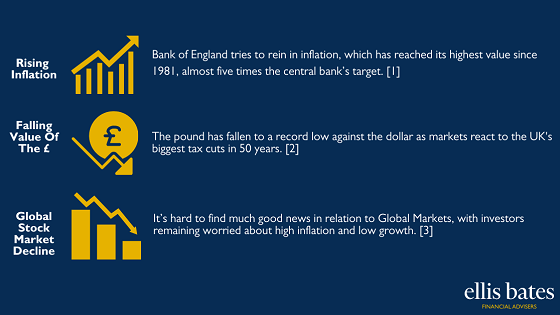
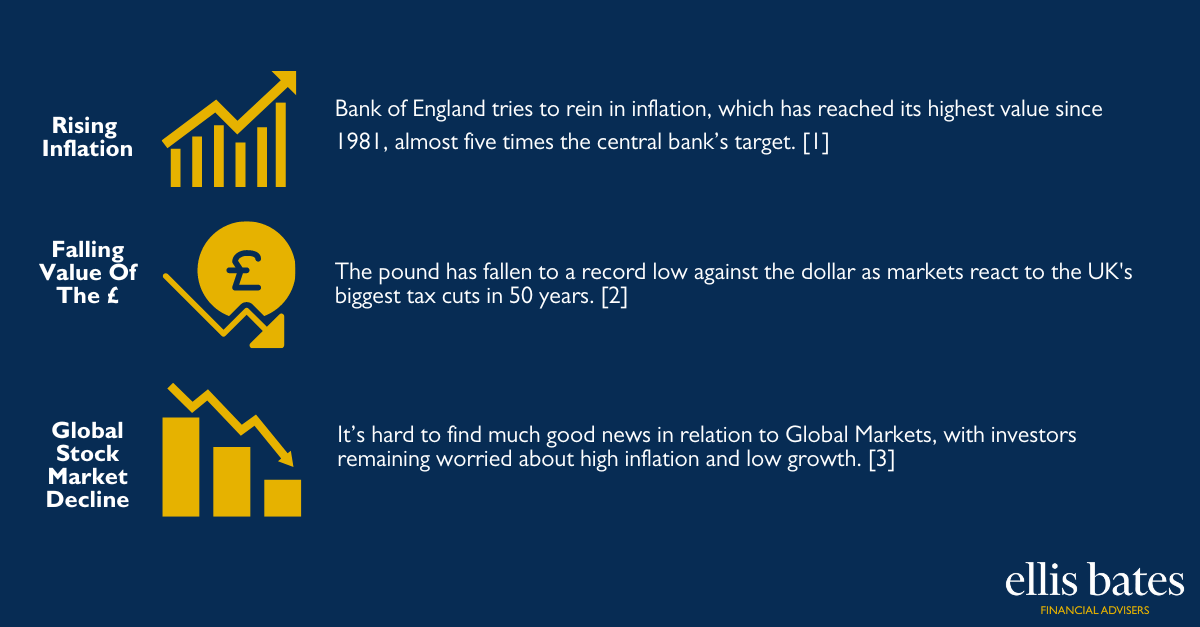
Rising Inflation

Bank of England tries to rein in inflation, which has reached its highest value since 1981, almost five times the central bank’s target. (1)

Falling Value of the £

The pound has fallen to a record low against the dollar as markets react to the UK’s biggest tax cuts in 50 years. (2)

Global Stock Market Declines

It’s hard to find much good news in relation to Global Markets, with investors remaining worried about high inflation and low growth. (3)

Sources
[1] https://www.bloomberg.com/news/articles/2022-09-26/understanding-the-british-pound-s-sudden-crash-quicktake
[2] www.bbc.co.uk
[3] https://russellinvestments.com/uk/blog/inflation-recession-earnings-mwir

Diversification Within Investments

150 150 Jess Easby

This session looks at how the strategy of diversification among investments can be used to reduce risk when investing.

Growing Pains?

560 315 Jess Easby

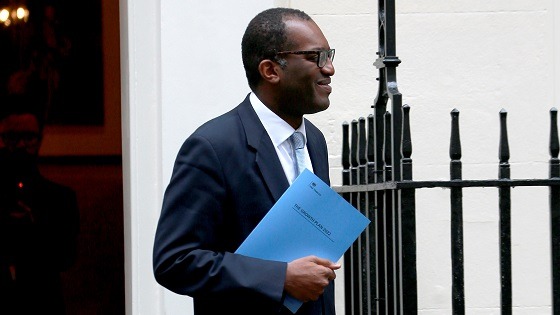
The UK’s new Chancellor Kwasi Kwarteng unveiled “The Growth Plan 2022” which marks a step change in government policy, both financially and ideologically. The view of the new government is summarised by the assertion that “Economic growth is the government’s central mission” and to achieve this “the government must cut taxes, streamline the public sector, and liberate the private sector.”

As always, we disregard the political or social biases with our comments and focus on the reality of facts, or importantly, the facts so far. As the chancellor noted when challenged on the financial prudence of their plan, the new regime had been in place 19 days when it was issued and there will be additional measures in the future. Those doubting the priorities of the government and where these measures will be implemented, however, need only to focus on the highlighted quotes from the mini-budget and then consider the likely economic implications.

Currency markets have been in focus as sterling initially reacted negatively to the news, with fears that the higher-than-expected levels of borrowing would cause sustained higher inflation and, in turn, higher interest rates from the Bank of England which would have significant implications on the cost of government financing at a time when this already stands at historical highs.

However, part of the uncertainty may be due to lack of detail on how the stimulus package would be financed which provides additional risk in market pricing – back to the relevance of the facts so far, and the likelihood of further communications within the theme of the government’s chosen central mission. A Conservative government that has just taken a very open and public step to the right will be acutely aware of the financial markets’ need for information and aversion to uncertainty, so we must assume a pro-business regime will adopt an operating framework to match.

What next? Initially, more uncertainty, particularly as the government and Bank of England (BoE) establish an equilibrium on fiscal stimulus and monetary restraint to break the cycle of higher inflation and higher interest rates. For growth to reach the government’s stated objective of 2.5% that will need to happen sooner rather than later, and more than likely after an almost inevitable initial recessionary period. The focus on the private sector should, in theory, be positive for businesses as the government has identified them as the solution to remedying the current economic problems. However, this is clearly a significant risk at a time when government finances are already stretched, and the macroeconomic environment is as uncertain at any point since the global financial crisis in 2007-08.

At our client webinars we have emphasised the likelihood of heightened volatility for a number of years and the implications for financial markets over the short, medium and long term. The short-term risks for UK-based investments have certainly increased with the announcements on Friday and what may be perceived as bold in some quarters has equally been dismissed as reckless in others. While clearly our portfolios are not immune to the prevailing negative market environment, we continue to emphasise the foundations for dealing with the current conditions lie in a well-diversified, global approach to assets that have long-term potential to weather the immediate storms and deliver returns over the longer term. Risks are clearly elevated at the moment and the government will need to provide more clarity on how the stimulus will be accounted for to soothe the nerves of investors.

Market volatility webinar feedback

560 315 Jess Easby

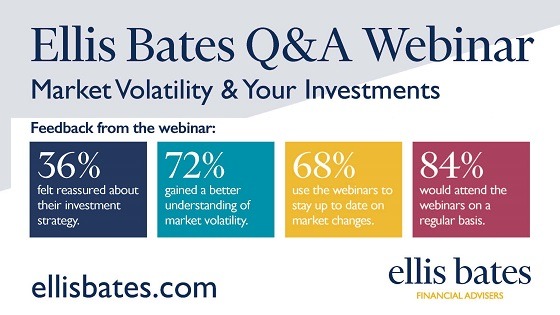
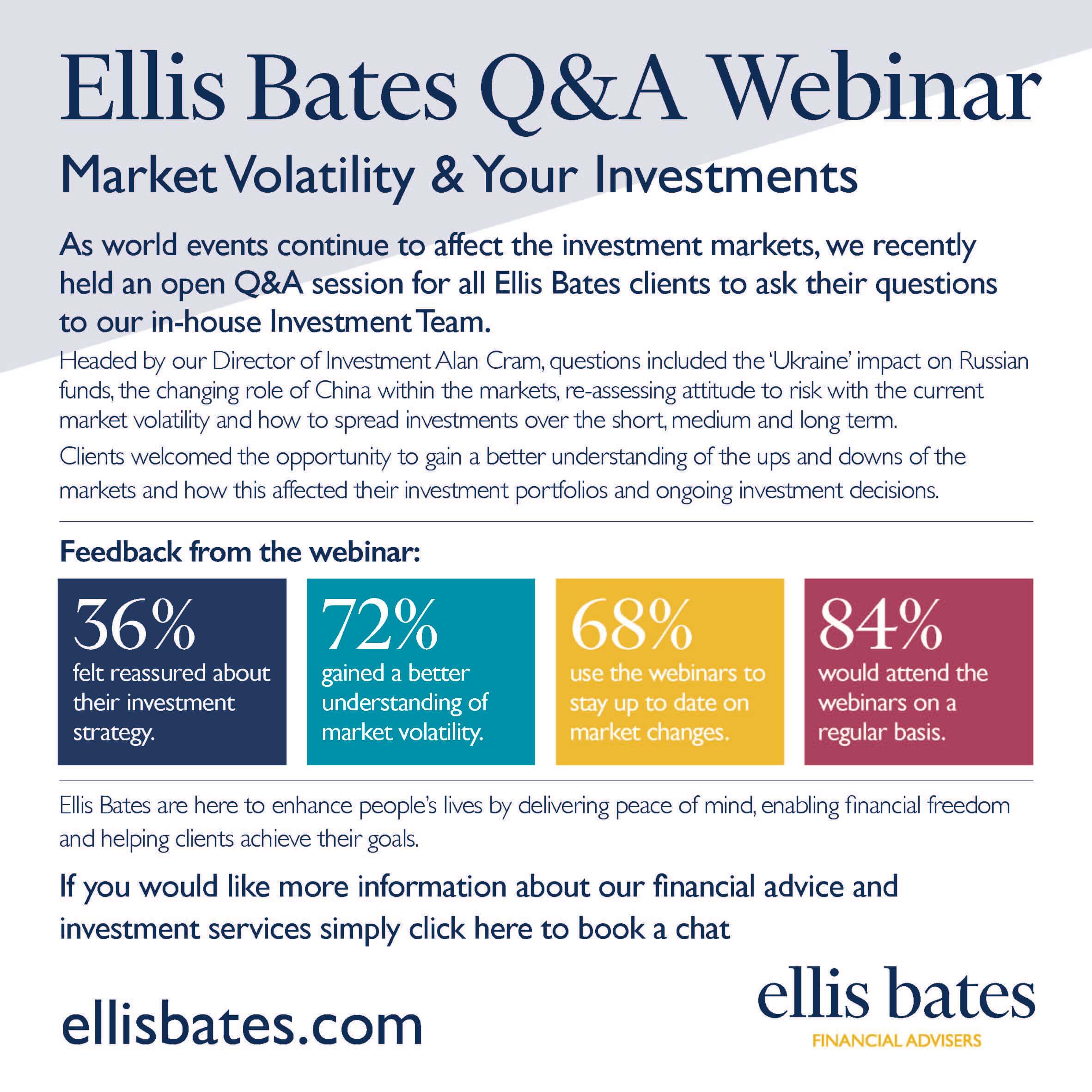
Ellis Bates Q&A Webinar

Market Volatility & Your Investments

As world events continue to affect the investment markets, we recently held an open Q&A session for all Ellis Bates clients to ask their questions to our in-house Investment Team.

Headed by our Director of Investment Alan Cram, questions included the ‘Ukraine’ impact on Russian funds, the changing role of China within the markets, re-assessing attitude to risk with the current market volatility and how to spread investments over the short, medium and long term.

Clients welcomed the opportunity to gain a better understanding of the ups and downs of the markets and how this affected their investment portfolios and ongoing investment decisions.

Ellis Bates are here to enhance people’s lives by delivering peace of mind, enabling financial freedom and helping clients achieve their goals.

If you would like more information about our financial advice and investment services simply book a chat.

a lady looking out of a window thinking about pension freedoms

Pension freedoms

560 315 Jess Easby

a lady looking out of a window thinking about pension freedomsPension Freedoms – Looking for a wider choice of investment options?


Saving for your retirement is one of the longest and biggest financial commitments you will ever make. Imagine you’re retiring today. Have you thought about how you’re going to financially support yourself (and potentially your family too) with your current pension savings? The pension freedoms introduced in 2015 provide even more of an incentive to look again at your retirement savings.

If appropriate to your particular situation, one option to consider is a Self-Invested Personal Pension (SIPP), especially if you’re looking for a wider choice of investment options. It’s an option for people who are more comfortable with investment risk and who have more time to regularly review their pension investments to make sure they continue to meet their needs.

Range and flexibility of investment

First introduced in 1989, this structure provides a range and flexibility of investment that makes a SIPP one of the most flexible methods of saving for retirement.

UK residents can invest money into a SIPP up until the age of 75, and start withdrawing money from as early as 55 (57 from 6 April 2028). Tax relief is available on personal contributions up to £3,600 or 100% of relevant UK earnings (whichever is greater), with tax-efficiency also subject to the pension annual allowance, which is £40,000 for most people and applies to contributions from all sources, including employer. Any unused allowance from previous years may mean more than £40,000 can be contributed tax-efficiently.

Saving for a child or grandchild

Parents can also open a Junior SIPP for their children. It may seem a little premature to start putting money into a SIPP for your child or grandchild at birth, but the tax relief that is available on the contributions makes this a particularly attractive way to save for your child’s future. The money is tied up until they reach retirement age, so this money will not be accessed any time soon.

As with all Defined Contribution pension schemes, the amount that you will have available when you retire depends on the contributions that you (and any employers) have made and how your investments perform over time.

Bring everything together in one place

If you’ve got several pensions, it could make sense to bring everything together in one place. Even if the amounts are small, it all adds up. You can transfer most types of pensions to a SIPP and combine them, letting you manage your pension pot in one place. But SIPPs are not suitable for every investor and other types of pensions may be more appropriate. Once in a SIPP wrapper, your savings will grow free from UK Income Tax and Capital Gains Tax.

Just starting your pension journey?

Investing your retirement savings in a SIPP may not be for everyone. If you are not sure which type of pension scheme is best for you, it’s essential you obtain professional financial advice to review your options. To find out more about pension freedoms and to discuss your options – please contact us.

A pension is a long-term investment not normally accessible until age 55 (57 from April 2028). The value of your investments (and any income from them) can go down as well as up which would have an impact on the level of pension benefits available. Your pension income could also be affected by the interest rates at the time you take your benefits.
The tax implications of pension withdrawals will be based on your individual circumstances, tax legislation and regulation which are subject to change in the future. You should seek advice to understand your options at retirement.
Accessing pension benefits early may impact on levels of retirement income and your entitlement to certain meanstested benefits and is not suitable for everyone. You should seek advice to understand your options at retirement.
Older man enjoying skiing in a bright orange jacket after not exceeding his lifetime allowance

Take it to the Max

560 315 Jess Easby

Older man enjoying skiing in a bright orange jacket after not exceeding his lifetime allowance

Feel confident about your retirement!

If you’ve been diligently saving into a pension throughout your working life, you should be entitled to feel confident about your retirement. But, unfortunately, the best savers sometimes find themselves inadvertently breaching their pension lifetime allowance (LTA) and being charged an additional tax that erodes their savings.

If you are a high-income earner or wealthy individual, you could be putting too much into your lifetime pension and risk exceeding the pension lifetime allowance.

The government will maintain the pensions Lifetime Allowance at its current level until April 2026, removing the usual annual incremental rises.

The following questions and answers are intended to help you avoid this tax charge.

Q: What is the lifetime allowance?

A: The LTA is a limit on the amount you can withdraw in pension benefits in your lifetime before you trigger an additional tax charge. By pension benefits, we mean money you receive from your pension in any form, whether that’s a lump sum, a flexible income, an annuity income or through any other method.

This allowance applies to your total pension savings, which may be in different pensions.

Q: How much is the allowance?

A: In the 2021/22 tax year, the LTA is £1,073,100. This allowance has now been frozen until April 2026.

Q: What happens if you exceed the allowance?

A: Once you have received your full LTA in pension benefits, you will be required to pay an additional tax charge on any further benefits you receive.

If you take your remaining benefits as a lump sum, you’ll pay a tax charge of 55%. If you take your remaining benefits as multiple withdrawals, you’ll pay a tax charge of 25% on each one.

Q: How is the usage of your lifetime allowance measured?

A: Each time you access your pension benefits (for example, by purchasing an annuity, receiving a lump sum or establishing a flexible income), this is recorded as a ‘benefit crystallisation event’. There is an additional benefit crystallisation event when you turn 75, and finally, upon your death.

Q: Is lifetime allowance protection available?

A: You can only protect your pension from the LTA if your savings were worth more than £1 million on 5 April 2016. You may be able to protect your pension savings up to £1.25 million, or up to the value of your pension on that date, depending on the type of protection you have.

Q: Is it possible to avoid the lifetime allowance?

A: If you do not have LTA protection and you are approaching the limit, there are various actions you can consider. These include stopping your contributions (and, instead, investing your money into an alternative tax-efficient environment), changing your investment strategy or starting retirement earlier.

Q: Who does the allowance affect most?

A: The LTA affects high earners and those approaching retirement age the most, including those with defined benefit pensions. As the value of high earners’ pensions rises over the next five years towards a lifetime limit that will remain fixed, more and more individuals may find they need to stop contributing to avoid breaching the limit.

Q: When should you seek professional advice?

A: The rules around the LTA are very complex and making the right decisions can feel difficult. Receiving professional financial advice will help to identify if you have a problem and offer different solutions to consider, based on a full review of your unique circumstances.

For more information on information regarding the Lifetime ISA, please get in touch!