

Retirement

Cost of living crisis

UK Cost of Living Crisis

560 315 Jess Easby

Cost of living crisisFunding the retirement lifestyle you want vs the cost of living: time to get your retirement plans in motion!

One of the most common concerns among those approaching retirement is whether they will have enough money to last them with only 25% of retirees feel very confident they’ve saved enough for retirement.

The cost of living crisis

As food prices continue to soar and petrol costs reach an all-time high in the UK, the rising cost of living is without doubt having an impact on many people’s financial plans, both short and long term.

If you’re approaching retirement or have already started taking money from your pension or other retirement savings, you wouldn’t be alone in feeling a little anxious about the effect the cost-of-living crisis might have on your lifestyle in retirement. While it’s impossible to predict the future with complete certainty, there are a few things you can do to feel more confident about spending your money in retirement.

Add up all sources of income

Your main source of retirement income may well be your pension plan. But when it comes to planning your finances in retirement, it’s important to think beyond this. Consider other potential sources such as Individual Savings Accounts (ISAs) and other investments, as well as any rental income you receive from rental properties you let.

Don’t forget the State Pension, which is currently £185.15 a week (£9,628 a year) for a single person with a full entitlement. Although the State Pension’s annual increase is currently below inflation, every little helps and the total of all your savings and income might add up to more than you think.

Watch out for unnecessary tax bills

Paying too much tax in retirement is a common pitfall for some retirees, and one that could be potentially avoided with having the right plans in place. If you’re already taking or plan to take income from multiple sources, you need to consider how that will be taxed. When and how you take your money can make a big difference to how much tax you pay and how long it will last. Taking money little and often could make all the difference when it comes to reducing your tax bill.

When it comes to your pension savings, you can typically take 25% tax-free from age 55 (age 57 in 2028), either in one go or spread out over a longer period. After this, any money you take from your pension savings, as well as your State Pension, is taxable just like any other income.

That means you’ll need to pay income tax on anything over your tax-free cash limit and any annual personal Income Tax allowance you get. It’s likely that the more money you take, the more tax you’ll have to pay, although how much will depend on which tax band your income falls into. So if you take all of your pension savings at once, or in big lump sums, you could be paying more tax than you need to. But by taking your pension savings over a number of years and taking just enough to stay in the lowest tax band you can, you could keep more of your money overall.

Make the most of your individual savings accounts (ISA)

Another way to avoid an unnecessary tax bill is to make the most of your ISA savings. You don’t pay tax on any investment growth or interest you earn, or on the proceeds you take from an ISA. So it’s a very tax-efficient way to save.

You could consider using any ISA savings you have first and delay accessing your pension savings, giving them more time to stay invested and potentially grow in value. Remember though, the value of all investments can go down as well as up, and you may get back less than you paid in.

Or, if you’ve already started taking an income from your pension, you could use your ISA savings to supplement that income. This could allow you to take smaller payments from your pension and avoid overpaying Income Tax on them. Getting to grips with tax implications can be a bit overwhelming as there’s a lot to consider.

Tax rules and legislation can change, and personal circumstances and where you live in the UK also have an impact on your tax treatment. On top of that, tax varies for other sources of income like property, state benefits, or even your salary if you’re planning on working in some capacity for a little longer.

Keep track of your investments

Where your money is invested could have the biggest impact on how long it will last in retirement. It’s important to regularly review your investments to make sure they remain on track and remain aligned with your plans and attitude to investment risk. For example, your pension savings may be invested in fairly high-risk funds that have the potential to grow significantly in value, but also are more likely to be impacted, particularly during periods of market volatility.

Moving to lower-risk investments means that you’re less likely to see big ups and downs in the value of your pension savings. However, if you’re relying on your pension savings to provide you with a comfortable income for the rest of your life, you also need to make sure that your investments will provide enough growth potential. This is particularly important in the current climate where your money faces the double challenge of rising inflation and potentially having to last for many years.

Want to review your retirement plans?

If you have specific questions about funding your retirement lifestyle, or if you’re feeling anxious about spending money in retirement, speak to us to discuss your options

Women Seeking Financial Support

150 150 Jess Easby

Financial Planner, Carol Lammy-Steele, discusses why women are less likely to seek financial support from a Financial Adviser.

Gender Pensions Gap

560 315 Jess Easby

Women’s pensions at retirement are half the size of men’s

The gender pensions gap is the difference in the average amount of money that men and women have saved for retirement and it begins at the very start of a woman’s career.

Women are more likely to take breaks from work to raise children or care for relatives, which can reduce their earnings and pension contributions over time. They also tend to live longer than men, meaning they need to have enough saved to last them through retirement.

As a result, women’s pensions at retirement are half the size of men’s, regardless of the sector they work in,
research has highlighted[1].

Long-term financial impact

The research found that every single industry in the UK has a gender pensions gap, even those dominated by female workers. Considering women are likely to live four years[2] longer than men, this issue deepens as they need to have saved around 5% to 7% more at retirement age.

Worryingly, more than a third (38%) of women who have taken a career break were not aware of the long-term financial impact it would have on their pension.

Three key industries

According to the research, the gender pensions gap exists regardless of average pay across different sectors, and ranges from a gap of 59% in the healthcare industry to 13% in courier services.

The healthcare (59%), construction (51%), real estate/property development (48%), pharmaceutical (46%), aerospace, defence and government services (46%) and senior care (45%) sectors were found to have the largest gender pensions gaps.

Of these six sectors, three are key industries for female employment – healthcare, pharmaceuticals and senior care[3]. There are many reasons for the gender pensions gap, ranging from women holding fewer senior positions and being paid less, resulting in lower pensions contributions, to the fact they are more likely to take career breaks due to caring responsibilities.

Gender confidence gap

Another potential driver is a significant gender confidence gap when it comes to managing pension pots. More than a quarter (28%) of women said they had confidence in their ability to make decisions about their pension, compared to almost half (48%) of men[5].

This lack of confidence extends further to other $nancial decisions, with women less likely than men to feel confident managing their investments (22% of women versus 41% of men) and their savings (56% of women versus 67% of men).

While many factors behind the gender pension gap are out of most people’s control, there are some actions you can take to help reduce it:

  • Contribute as much as you can to your pension – and start early.
  • Compound interest remains hugely underrated and poorly understood by both some men and women.
  • Check the charges on your historic pension pots. If appropriate, see if consolidating your pots will bring them down.
  • Check how much your State Pension will be and when you’ll get it. If it’s not going to support your ideal lifestyle, plan how you’ll cover any shortfall.
  • Put a bit more into your pension whenever you get a pay rise.
  • Talk through your pension planning with your partner. Make sure you know about each other’s saving plans, contribution limits and that you are both on the same page.
  • Keep a regular eye on your pension to make sure you’re in full control of it and saving for your ideal future.

There are a number of ways to close the gender pensions gap. Employers can offer flexible working arrangements that allow women to balance work and family life. Governments can also provide tax incentives for pension contributions. And finally, individuals can look to save
more for retirement.

Source data:
[1] The analysis is based on LGIM’s proprietary data on c.4.5 million defined contribution members as at 1 April 2022 but does not take into account any other pension provision the customers may have elsewhere.
[2] ONS: Life expectancy at birth in the UK: 82.9 years for women vs 79 years for men; Office for National Statistics, 2018–2020. Average four years.
[3] According to the ratio of female members across the Legal & General book of business.
[4] Legal & General Insight Lab survey of 2,135 workplace members was conducted between 4–26 July 2022.
[5] Opinium survey of 2,001 UK adults was conducted between 4–8 February 2022.

Tax Planning in Retirement

150 150 Jess Easby

Managing Director and Chartered Financial Planner, Michael Cope, discusses tax planning in retirement.

Worries About Retirement

560 315 Jess Easby

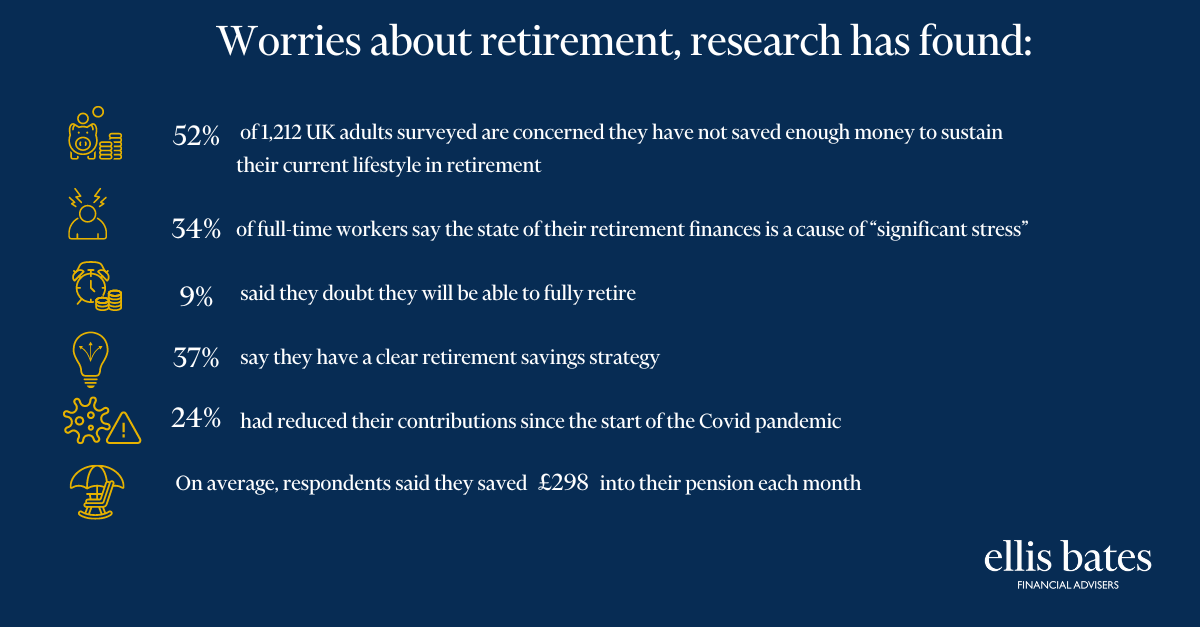
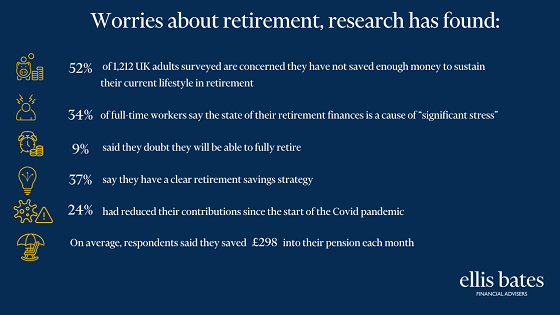
Worries about retirement, research has found:

52% of 1,212 UK adults surveyed are concerned they have not saved enough money to sustain their current lifestyle in retirement

34% of full time works say the state of their retirement finances is a cause of “significant stress”

9% said they doubt they will be able to fully retire

37% say they have a clear retirement savings strategy

24% had reduced their contributions since the start of the Covid pandemic

On average, respondents said they saved £298 into their pension each month

Steps to Retirement

560 315 Jess Easby

Step One: think ahead to the type of retirement you want

The first step is always to have an idea of what you want to do when you eventually stop work. It is helpful to have a good idea of the lifestyle you want, how much it will cost and how you are going to pay for it. You may want to travel, spend more time with family and friends, pursue hobbies and interests or move house. However you see your retirement, itis important to think ahead, plan ahead and cost up how much this may cost so you put a savings/investing plan in place.

Step Two: plan to cover your costs

You will need to make sure that you have enough saved up to cover your basic costs including living expenses and any debts or financial obligations you may have. You will need to look at your current savings levels, investments, pensions etc and map them all out to see what you already have/expect to have and then to put additional savings/pension contributions plans in place. Once this is done you will have a better idea of how much you will need to retire. At Ellis Bates we use sophisticated cashflow to map out your income and expenditure and map these against your retirement goals to bring your retirement journey to life. Hop over to  https://www.ellisbates.com/retirement-calculator/to add in some overview numbers to get an idea of how much you will need to retire.

Step Three: be enthusiastic

Retirement planning is complex but the more enthusiastic you are about retiring, the more likely you are to develop a robust retirement plan and retire at the age you want to and with the lifestyle you want.

Step Four: factor in inflation

The cost of living will go up as we are seeing currently, so you’ll need to make sure that your savings and investments including your pensions not only keep can keep pace with inflation but keep ahead if possible so that your buying power is not eroded.

Step Five: seek impartial advice

External advice compensates for any emotional biases you may have about making big financial decisions. A DIY approach to managing large pension funds at retirement is fraught with risk. People can easily buy the wrong products, incur unnecessary tax bills or simply exhaust their retirement funds too quickly, whereas an adviser will provide an impartial, cool-headed approach to your finances and offer solutions you will not have considered. Obtaining expert professional financial advice will ensure you are on track to meeting your goals. The sooner you start planning, the more likely you are to achieve a comfortable retirement, at an age you choose. We can help you calculate how much you need to retire, simply book a free consultation.

Millions of married couples have no idea about their spouse’s pensions & retirement plans

560 315 Jess Easby

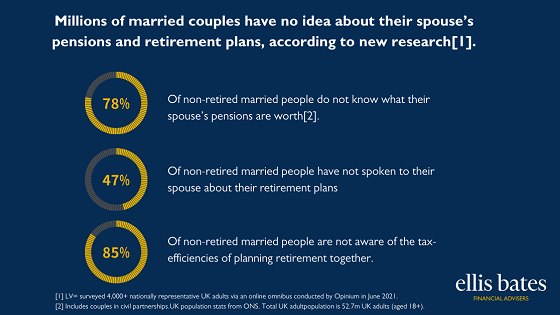
Millions of married couples have no idea about their spouse’s pensions and retirement plans, according to new research

78% of non-retired married people do not know what their spouse’s pensions are worth.

47% of non-retired married people have not spoken to their spouse about their retirement plans

85% of non-retired married people are not aware of the tax-efficiencies of planning retirement together

Pensions & Retirement Still Remain a Taboo

560 315 Jess Easby

When it comes to marriage and money, it’s good to talk!

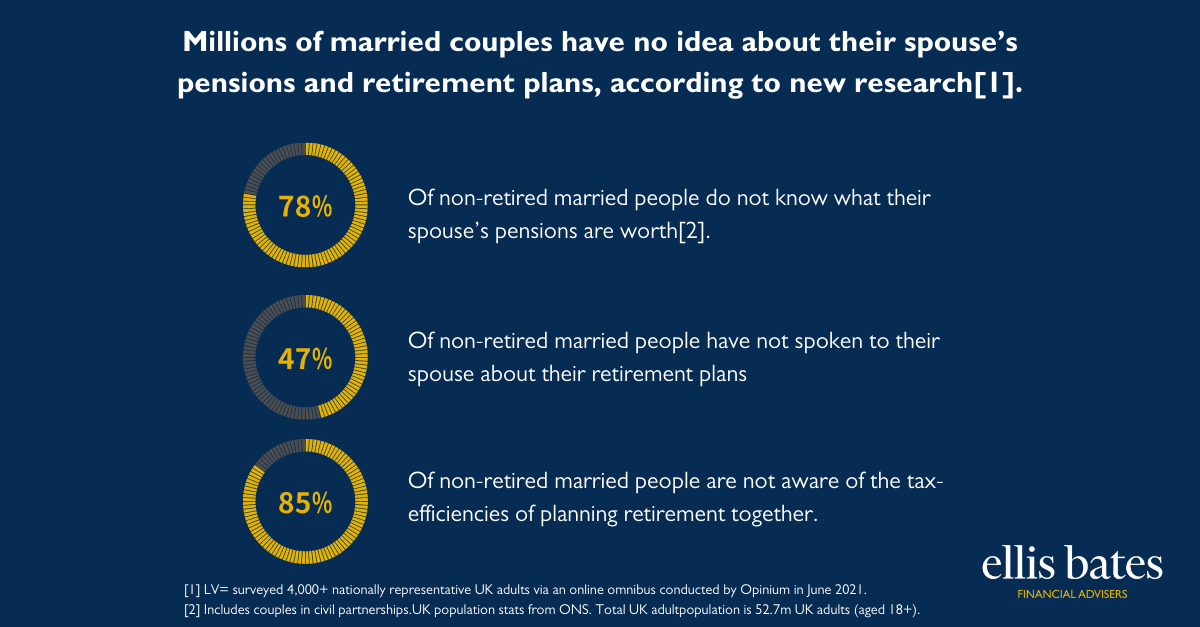
Millions of married couples have no idea about their spouse’s pensions and retirement plans, according to new research[1]. More than threequarters (78%) of non-retired married[2] people do not know what their spouse’s pensions are worth.

Nearly half (47%) of non-retired married people have not spoken to their spouse about their retirement plans and 85% of non-retired married people are not aware of the tax-efficiencies of planning retirement together.

Retirement finances

Wealthy people aren’t doing much better. Mass affluent people (those with assets of between £100,000 and £500,000 excluding property) are more likely than average to be aware of the value of their spouse’s pension, but the majority (60%) aren’t going to plan their retirement finances with their spouse and 78% aren’t aware of the benefits of planning retirement together.

The research indicates that millions of married people are not talking to their partners about their pensions and retirement plans. That’s a mistake because couples who jointly plan their retirement can be much better off when they stop working.

Lifetime of saving

Most people have a good idea of what their house is worth, and the same attitude should apply to their retirement funds. After a lifetime of saving, the value of a retirement fund can be worth as much as a property so it’s important that people know how much their retirement savings are worth and the potential death benefits they offer.

The best way for people to ensure they have the retirement they want, their pension income lasts throughout their retirement and that they avoid unnecessary tax bills is to obtain professional financial advice. This is especially true for people who plan to retire within the next five years.

Pension tips for couples

  • Pay into your partner’s pension: A higher-earning partner approaching the Lifetime Allowance or Annual Allowance could pay additional contributions into their partner’s pension. The contributions will attract tax relief.
  • Don’t forget the death benefits and Inheritance Tax benefits of pensions: Pensions won’t normally form part of the estate for Inheritance Tax purposes and, on death before age 75, they can usually be paid out tax free (on death after 75, they are taxed as the beneficiary’s income). It can make sense to discuss when and how to access a pension and if it would be better to spend any other savings first.
  • Avoid unnecessary large withdrawals from a pension fund: Couples should consider how much money they need to withdraw from their pension funds. Drawing too much too quickly can lead to large tax bills.
  • Make sure your partner knows who to contact about your pensions if you die: You may have carefully arranged all your finances so that they can be passed to your loved ones in the most tax-efficient way possible. However, if your partner hasn’t been part of the conversation they may make uninformed decisions. It’s worth remembering that any adviser/client relationship you have ends on death. Data protection rules mean your financial adviser won’t necessarily know what is happening. This can lead to irreversible and costly mistakes being made.

On retirement, many people’s first instinct is to request their full tax-free cash entitlement. However, unless a large lump sum is needed
for a specific purpose, this is not always the wisest course of action. If flexibly accessing a pension, it can often make sense for couples to retain most of the tax-free cash entitlement until a later date, looking to utilise the personal allowance (and potentially the basic rate tax band) to draw tax-efficient income instead.

Successfully managing finances in marriage

When you and your spouse married, you agreed to share a financial future. It’s an important issue for most married couples. Although successfully managing finances in marriage is essential to your happiness together, talking about money may not come naturally. To discuss how we could help you plan your finances, please contact us for more information.

Source data: [1] LV= surveyed 4,000+ nationally representative UK adults via an online omnibus conducted by Opinium in June 2021. [2] Includes couples in civil partnerships. UK population stats from ONS. Total UK adult population is 52.7m UK adults (aged 18+).

Options at retirement

560 315 Jess Easby

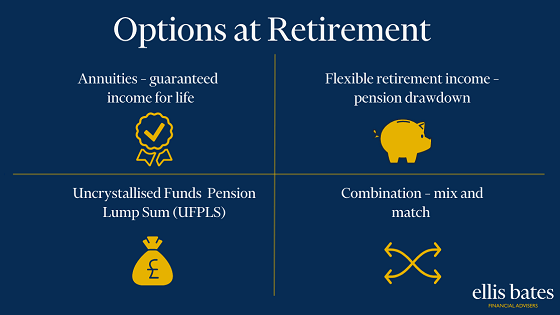
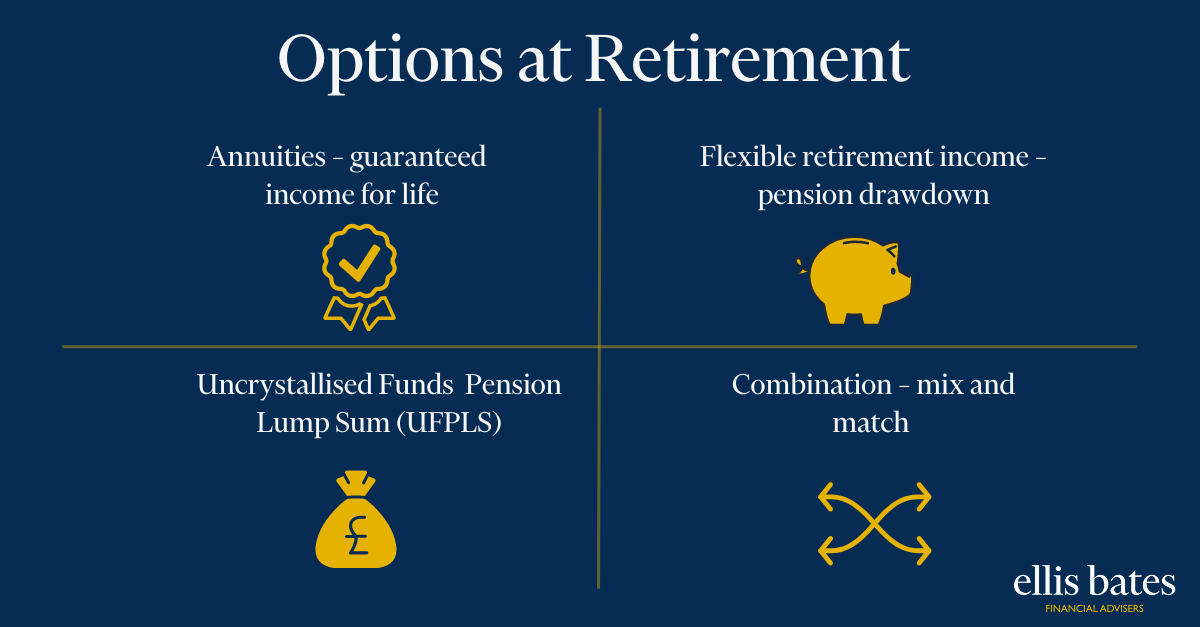
Options at retirement

Annuities – guaranteed income for life

Flexible retirement income – pension drawdown

Uncrystallised Funds Pension Lump Sum

Combination – mix and match

a couple happy at their options at retirement

Pension options at retirement

560 315 Jess Easby

a couple happy at their options at retirementWhat can I do with my pension?

Deciding how you want to start taking money.

Due to the changes introduced by the government in April 2015, when you reach the age of 55 (subject to change) you now have more flexibility than ever when it comes to taking money from your pension pot.

But before you do anything with your hard-earned cash, it’s important to take the time to understand your options, as the decisions you make will affect your income in retirement. Before you take money from your pension plan, it’s important to ask yourself if you really need it right away.

When and how you take your money can make a big difference to how much tax you might pay and how long your money will last.

Most pensions will set an age from which you can start taking money from your pension. They will also have rules for when you can
take your pension earlier than normal, for example, if you become seriously ill or unable to work.

When the time comes to start taking money from your pension, you’ll need to decide how you want to do this. If you’ve got a personal
pension or a defined contribution pension, you can take up to 25% of its value as a tax-free lump sum.

The remainder of your pension fund will be taxable and may either be taken as cash, used to buy an annuity (a guaranteed income for a
specific period or for the rest of your life), or you may leave the money invested and take withdrawals on a regular basis or as and when
you need.

With a defined benefits pension, you may be able to take some of its value as a tax-free lump sum, but this will depend on the rules of your scheme. The rest of the money will be paid to you as a guaranteed income for the rest of your life.

Different levels of risk and security and potentially different tax implications

The different ways of taking your money have different levels of risk and security, and potentially different tax implications too. As with all retirement decisions, it’s important to take professional financial advice on what’s best for you.

Everybody’s situation is different, so how you combine the options is up to you.

Annuities – guaranteed income for life

Annuities enable you to exchange your pension pot for a guaranteed income for life. They were once the most common pension option to fund retirement. But changes to the pension freedom rules have given savers increased flexibility.

The amount you will receive depends on a number of factors, for example, how long the insurance company expects you to live and other benefits the annuity provides, such as a guaranteed payment period or payments to a spouse or dependent.

Annuities can also be for a specific period, not just for life. This can be useful if someone wants a guaranteed income for part of their retirement, say before the State Pension is payable.

Flexible retirement income –pension drawdown

When it comes to assessing pension options, flexibility is the main attraction offered by income drawdown, which allow you to access your money while leaving it invested, meaning your funds can continue to grow.

Pension drawdown normally allows you to draw 25% of your pension fund as a tax-free lump-sum, or series of smaller sums. This ‘tax-free cash’ is known as the Pension Commencement Lump Sum, or PCLS. The rest of the fund remains invested and is used to provide you with a taxable income, via withdrawals on a regular basis or as and when you need.

You set the income you want, though this might be adjusted periodically depending on the performance of your investments. You need to manage your investments carefully because, unlike a lifetime annuity, your income isn’t guaranteed for life.

Uncrystallised Funds Pension Lump Sum (UFPLS)

You do not have to draw your pensions commencement lump sum at the outset. Instead you may use your pension fund to take cash as and when you need it and leave the rest untouched where it can continue to grow tax-free.

For each withdrawal, the first 25% (quarter) is tax-free and the rest counts as taxable income. There might be charges each time you make a cash withdrawal and/or limits on how many withdrawals you can make each year.

Combination – mix and match

It may suit you better to use a combination of the options outlined above. You might want to use some of your savings to buy an annuity to cover the essentials (rent, mortgage or household bills), with the rest placed in an income drawdown scheme that allows you to decide how much you wish, and can afford, to withdraw and when.

Alternatively, you might want more flexibility in the early years of retirement, and more security in the later years. If that is the case, this may be a good reason to delay buying an annuity until later.

Want to discuss how to decide what to do with your pension pot?

Find out more about your options for taking an income in retirement and what you need to consider. If you’re unsure about the best approach for you, please get in touch with us for further information.